INTRODUCTION
This topic is about the first stages of the language in babies, the prelanguage has been studied by some linguists that had found some special cases where the babbies can develop their skills and getting more information around them.

Esther Sierra: My name is Esther Sierra. I'm 23 years old. I from Honduras . I live in neighborhood Venezuela. I live with my parents. I have three sisters and one brother. I study at the university foreign languages and I will be the best teacher.
MARIO SERVELLON
25 years old Foreign languages student from Honduras, Studying at the UNAH working hard ,with determination and giving my best to become a great teacher.
VICTOR GARCIA
My name is Víctor, I'm 25 years old. I'm from Tegucigalpa, Honduras. I really like foreign language to have a better opportunity to for my future.
STAGES IN FIRST LANGUAGE ACQUISITION
HOLOPHRASIS
Holophrasis is the prelinguistic use of a single word to express a complex idea. A holophrase may resemble an interjection, but whereas an interjection is linguistic, and has a specific grammatical function, a holophrase is simply a vocalization memorized by rote and used without grammatical intent.
The nation
that a person is born with a mind like a blank Stage is belied by a wealth of
evidence that newborns reacts to some subtitle distinctions in their environment
and not to others.
Children can perceive voicing contrasts. In this case costraste place of articulation some cases the babies perceive that we are spoken; any vowels or only the sound.
When the child begins start listening to and then they are using their utterances, the child’s first words may differ from the words of the adults language
Why is called the holophrastic or “whole phrase”; because in this case it is similar the first word but there are from their utterances consist of only one word.
Children can perceive voicing contrasts. In this case costraste place of articulation some cases the babies perceive that we are spoken; any vowels or only the sound.
When the child begins start listening to and then they are using their utterances, the child’s first words may differ from the words of the adults language
Why is called the holophrastic or “whole phrase”; because in this case it is similar the first word but there are from their utterances consist of only one word.
TELEGRAPHIC
Telegraphic speech, according to linguistics and psychology, is speech during the two-word stage of language acquisition in children, which is laconic and efficient. The name derives from the fact that someone sending a telegram was generally charged by the word.
Telegraphic stage
Several months later children begin to produce longer and more complex grammatical utterances, such as chair broken, what her name, me wanna show Mummy. This stage generally occurs from 24-30 months.
Since the sentences produced during this stage are similar to the information found in the telegrams this stage is known as the telegraphic stage.
During this stage children do not appear to commonly make word order errors even though the sentences are shortened. The order of the subject, verb and object is mostly correct, but increases during the later months of this stage. Children develop rapidly from age two onward and can move from relatively simple two-word utterances to a broad range of utterances within just a few short months.
The most common words are the words of this stage include social interaction - for example, please, bye and no. Over the next months, this vocabulary grows by as much as ten or twelve new words a day. By age six most children have mastered about thirteen thousand words.
SLIDES
Stages of Acquisition of first Language from Joel Acosta
BABBLING

Perception and production of speech sounds
The production of speech sounds
Reflections
the topic show how to detect the babie's language, they imitate the sounds around them and naturality they try to perform the same sound, by default as human we are always learning by listening and hearing.
#2
This show us every stage in a detailed way so that we learn more about it and how the human being develops the ability of speaking
It is very peculiar how babies begin babbling and pronouncing words as they hear repeatedly.
DISCUSSION QUESTIONS
1.What is babbling?
2.Mentions the different parts of the vocal tract
3.why is it called holophrasic stage?
4.how is the second stage in language acquisition called?
5.Write examples about the most common
words are the words used by children in the telegraphic stage.
USEFUL LINKS
http://firstwords.ca/learning-tools/
https://www.ncbi.nlm.nih.gov/pmc/articles/PMC3740754
https://www.ncbi.nlm.nih.gov/m/pubmed/5538846/
REFERENCES
BABBLING
'Blah, blah, la, la.' To an adult, these babbling noises are meaningless, but to an infant they are the beginnings of speech. These sounds are practice for what will eventually become words, phrases, and sentences full of meaning, thought, and emotion.
Babbling is the term for the second stage of speech development after the newborn stage of crying. Anyone who has been around a newborn knows they cry when they're hungry, cold, sick, or in need of changing. Some cry because they just want to be held. Babbling is the next step, when an infant aged about five months to one and a half years begins to make individual sounds like 'mamama' and 'bababa.'
Babblers make these easy sounds because they do not have teeth, which are necessary for making 'th' and 'sh' sounds. At this stage, babblers are also just starting to control their facial and tongue muscles. Ever wonder why the word for 'mother' in most language begins with the 'ma' sounds? Because it is one of the easiest sounds for babies to produce, and it is a pretty important word.
Purpose of Babbling
So what is the purpose of babbling? Babblers make eye contact while babbling and begin to assert their intentions and emotions. A frustrated 'baba' sound might mean 'I want my bottle NOW. I am starving.' They laugh and smile while babbling because something delights them. They pause and wait for their listeners to talk with them and engage them further. This rewards the babies' efforts because someone is listening to them, which makes them more likely to babble. They are also rewarded by the joy they sense from their mothers' facial expressions and behavior when they say 'mama' for the first time, a first word for most babies.

Perception and production of speech sounds
Speech perception in infants.
speech sound was studied in 1- and 4-month-old infants. The speech sounds varied along an acoustic dimension previously shown to cue phonemic distinctions among the voiced and voiceless stop consonants in adults. Discriminability was measured by an increase in conditioned response rate to a second speech sound after habituation to the first speech sound. Recovery from habituation was greater for a given acoustic difference when the two stimuli were from different adult phonemic categories than when they were from the same category. The discontinuity in discrimination at the region of the adult phonemic boundary was taken as evidence for categorical perception.The production of speech sounds
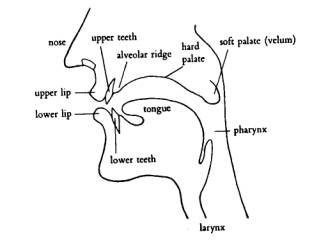
All the sounds we make when we speak are the result of muscles contracting. The muscles in the chest that we use for breathing produce the flow of air that is needed for almost all speech sounds; muscles in the larynx produce many different modifications in the flow of air from the chest to the mouth. After passing through the larynx, the air goes through what we call the vocal tract, which ends at the mouth and nostrils. Here the air from the lungs escapes into the atmosphere. We have a large and complex set of muscles that can produce changes in the shape of the vocal tract, and in order to learn how the sounds of speech are produced it is necessary to become familiar with the different parts of the vocal tract. These different parts are called articulators, and the study of them is called articulatory phonetics.
Fig. 1 is a diagram that is used frequently in the study of phonetics. It represents the human head, seen from the side, displayed as though it had been cut in half. You will need to look at it carefully as the articulators are described, and you will often find it useful to have a mirror and a good light placed so that you can look at the inside of your mouth.
Reflections
the topic show how to detect the babie's language, they imitate the sounds around them and naturality they try to perform the same sound, by default as human we are always learning by listening and hearing.
#2
This show us every stage in a detailed way so that we learn more about it and how the human being develops the ability of speaking
It is very peculiar how babies begin babbling and pronouncing words as they hear repeatedly.
DISCUSSION QUESTIONS
1.What is babbling?
2.Mentions the different parts of the vocal tract
3.why is it called holophrasic stage?
4.how is the second stage in language acquisition called?
5.Write examples about the most common
words are the words used by children in the telegraphic stage.
USEFUL LINKS
http://firstwords.ca/learning-tools/
https://www.ncbi.nlm.nih.gov/pmc/articles/PMC3740754
https://www.ncbi.nlm.nih.gov/m/pubmed/5538846/
REFERENCES
Eimas PD, et al. Science. 1971.


No hay comentarios.:
Publicar un comentario